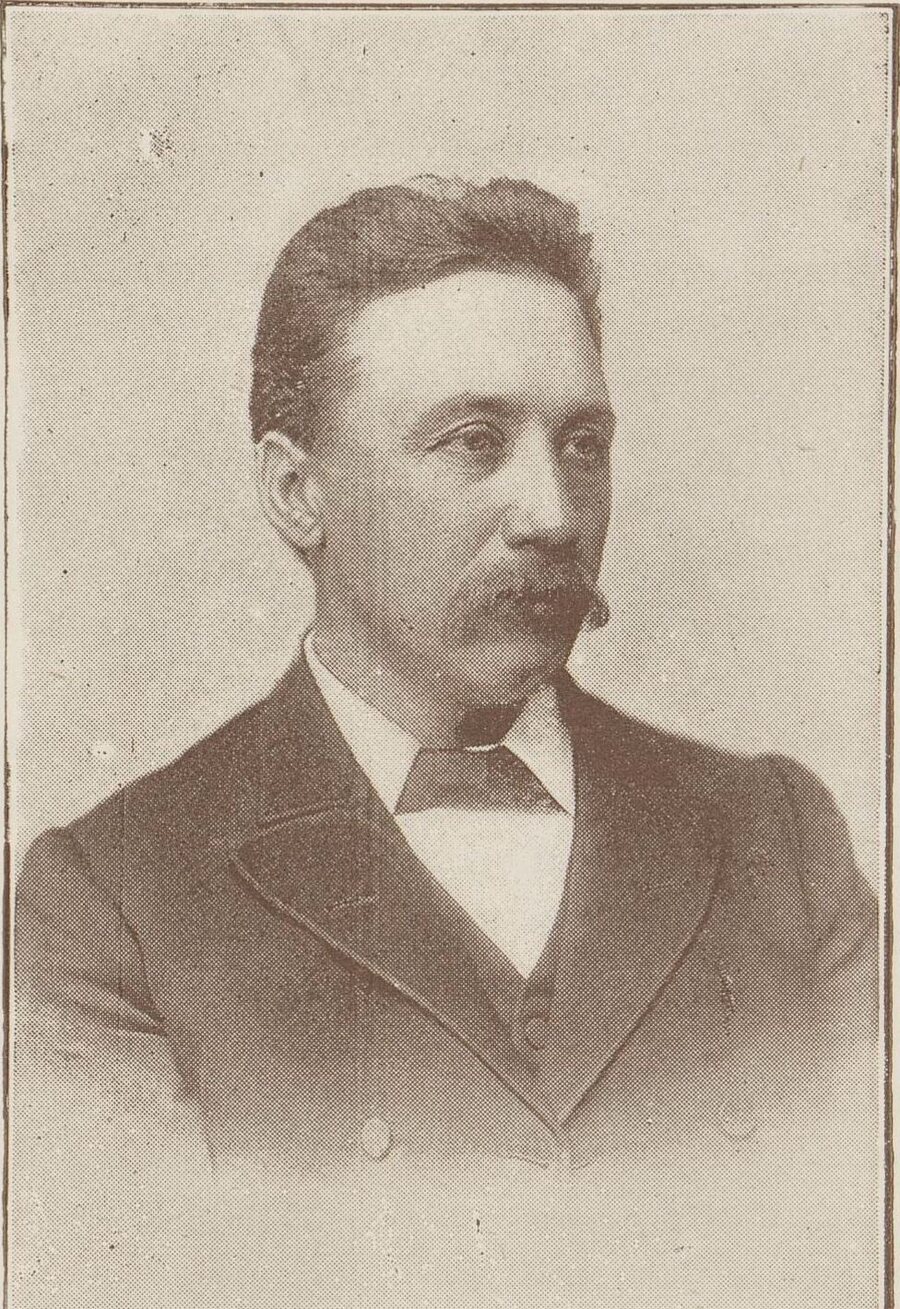
Thomas Spurgeon, c. 1890–1895. Autotype print, anonymous. Rijksmuseum, Amsterdam, RP-F-F26790 (CC0).
Edison-Bell cylinder · 2 August 1905 · 2 min 31 s
Thomas Spurgeon at the Phonograph
No recording of Charles Haddon Spurgeon exists. The nearest thing is his son and successor reading his father's last printed words into a phonograph, thirteen years after the father's death. This page traces where that recording came from, sets out every step taken to make it easier to hear, and lets you switch between the raw transfer and the restored version while it plays.
SpeakerThomas Spurgeon (1856–1917)
TextClose of C. H. Spurgeon's final Tabernacle sermon, 7 June 1891
Digital source64 kbps MP3, via Justin Taylor, 2013
RestoredSeptember 2026
ListenBoth versions play in lockstep. Switch between them at any moment.
Space play · T switch · ←→ 5 s
AnnouncementPrefaceRecitation
0:00.0 / 2:31.1
Waveforms are each drawn at their own peak level so their shapes can be compared. The restored master sits about two decibels below the transfer, so for switching the original is turned down to match. Neither is otherwise altered for playback here. There is also a before-and-after cut on YouTube, each part played twice.
0:00.0
Thomas Spurgeon, 2 August 1905
Where it comes from
A voice that was never recorded, and the son who stood in for it
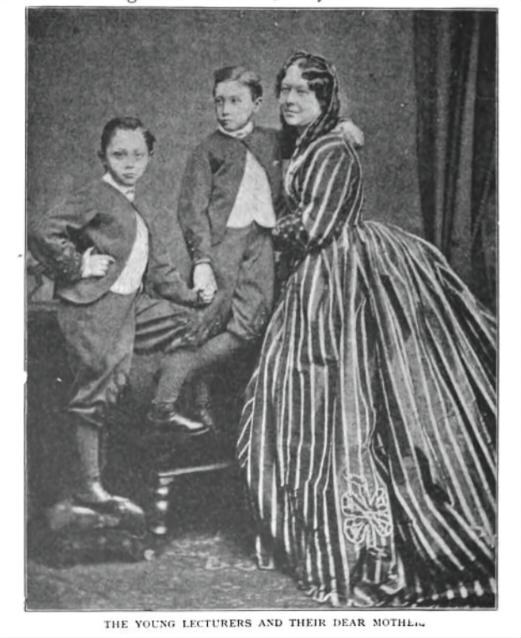
Charles Spurgeon and Susannah Thompson married in January 1856. Fraternal twins, Charles and Thomas, were born that September. After the father's death in January 1892, Thomas came back from New Zealand, where he had been ministering, and in 1894 took his father's pulpit at the Metropolitan Tabernacle, the vast London chapel built for Charles in 1861.
Comparisons were unavoidable. W. Y. Fullerton's biography of Thomas, published two years after his death, records how he appeared from the pews:
Seen from the midst of the congregation he is not very dissimilar in appearance from his father. There is the frock coat, the little black tie, the quiet self-possessed demeanour, the clear, studied articulation; a voice, not quite that of Charles Spurgeon, not quite so strong and not quite so musical, so marvellously expressive and flexible, as his father's, but clear and pleasant and melodious, and with many of the late pastor's modulations and inflexions.
Many of the gifts of his father—though no doubt in smaller measure—he certainly possesses, and every here and there one might have shut one's eyes and fancied that it was the old pastor back again.
On 2 August 1905, during that pastorate, Thomas spoke into an Edison-Bell phonograph. He recorded a short preface of his own, and then the closing paragraph of the last sermon his father had preached at the Tabernacle, on 7 June 1891. Edison-Bell was the London company that held the British rights to the cylinder phonograph. Whether the surviving audio was cut on a wax cylinder that day, or copied later onto another carrier, is not something the surviving file can tell us.
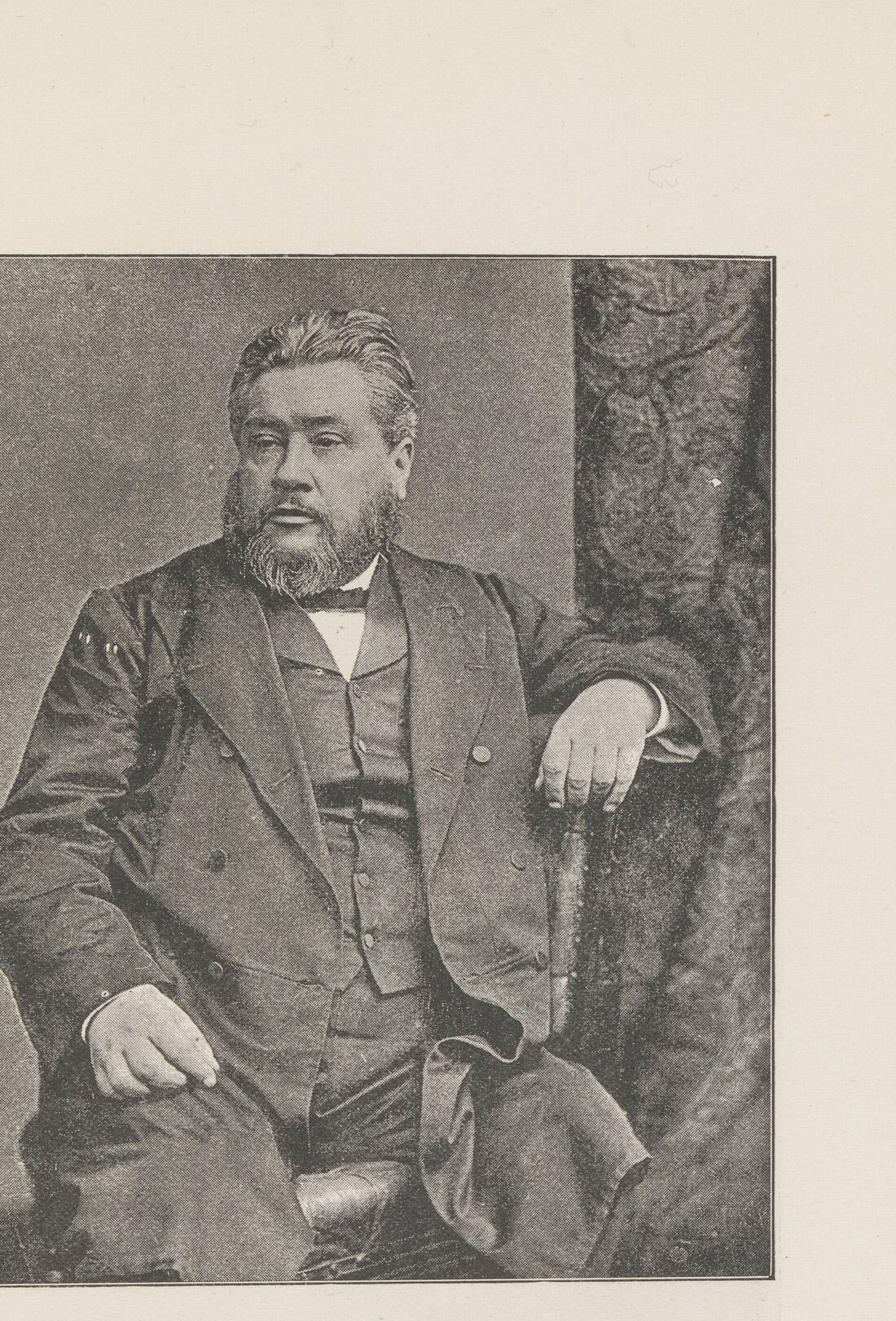
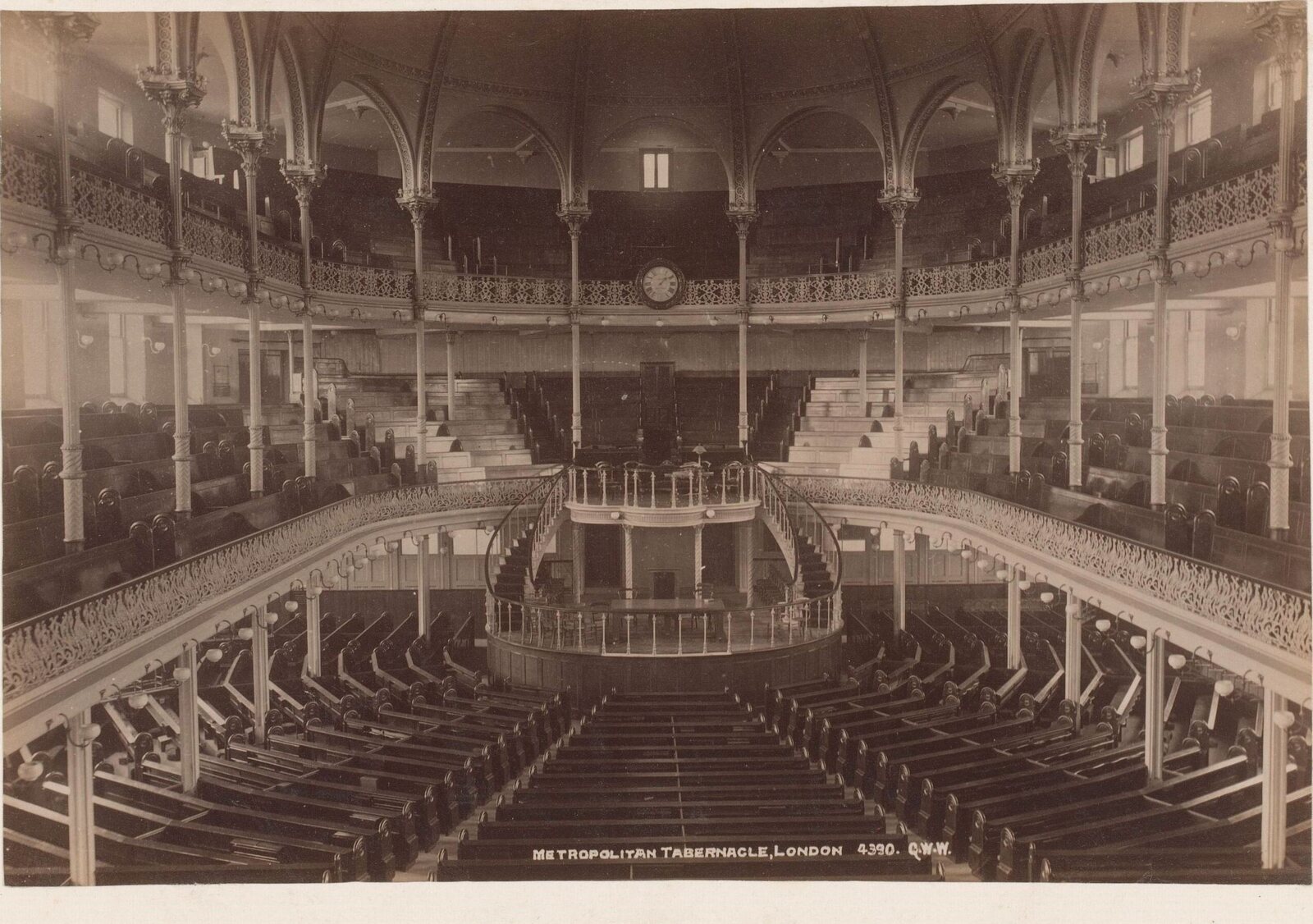
Charles Haddon Spurgeon, photographed by the London Stereoscopic Company, c. 1881–1891. Rijksmuseum, RP-F-2001-7-67-53 (CC0).The Metropolitan Tabernacle from the rear gallery, albumen print by George Washington Wilson, c. 1875–1900. Rijksmuseum, RP-F-00-6310 (CC0).Susannah Spurgeon with the twins, captioned “The young lecturers and their dear mother.” From C. H. Spurgeon's Autobiography (1903). Public domain.
How the file reached this page
The digital audio used here came to the project through a 2013 blog post by Justin Taylor, “What Did Charles Spurgeon Sound Like? A Recording of His Son”, published on The Gospel Coalition on 10 October 2013. Taylor credited the recording to Spurgeon Online, by way of Steve Weaver at Confessing Baptist, and hosted an MP3 whose filename carries the SermonAudio catalogue number 61212024192 and a catalogue date of 12 June 2012. That file is the “original” everywhere on this page. It was downloaded again from Taylor's post on 9 September 2026 and its SHA-256 digest matched the project's copy exactly.
Taylor closed his post with a parenthetical invitation: “If there are any audio engineers out there who want to engineer a better quality version, let me know.” This page is one answer, offered thirteen years late and with more caveats than he probably bargained for.
Two things about the word “original” need saying plainly. The file is a 64 kilobit-per-second mono MP3, which is a lossy copy of some earlier transfer, which was itself made from a carrier nobody involved in this work has seen. Its catalogue tags name the artist as C. H. Spurgeon, which is attribution, not identification. And the voice that reads the opening announcement may not be Thomas at all. Those uncertainties are inherited by everything that follows.
What was said
The words on the cylinder
Select any line to hear it. The text is the working transcript used throughout the restoration, checked against the sermon as Spurgeon printed it. Dotted words are ones an automatic speech recogniser heard differently on the restored audio. They were left as the transcript has them, and the audio was never altered to make a recogniser agree.
Announcement0:01 – 0:17 · speaker uncertain
Preface0:18 – 0:56 · Thomas Spurgeon
Recitation0:57 – 2:27 · C. H. Spurgeon's words, 7 June 1891
Against the printed page
The recited passage is the last paragraph of “The Statute of David for the Sharing of the Spoil,” preached at the Tabernacle on the morning of 7 June 1891 and printed in volume 37 of the Metropolitan Tabernacle Pulpit. It was the last sermon Charles preached there. Set beside the print, Thomas's recitation departs from it in three places, each easy to understand.
He starts mid-sentence. The print runs “You will find sin, self, Satan, and the world to be hard masters; but if you wear the livery of Christ…” Thomas begins at “If you wear.”
He leaves out a sentence his father spoke in his own person. Between “you always find it in him” and “His service is life, peace, joy,” the print has: “These forty years and more have I served him, blessed be his name! and I have had nothing but love from him. I would be glad to continue yet another forty years in the same dear service here below if so it pleased him.” A son could not read that as his own, and Thomas omits it.
He changes the last line. The print closes “God help you to enlist under the banner of Jesus even this day! Amen.” Thomas says “under the banner of Jesus Christ!”
Everything else is the printed text word for word. That is why the transcript can be trusted where the audio alone is ambiguous: “meek,” “rest unto your souls,” “bids us,” “gracious,” “yea” and “enlist” are all what Spurgeon printed, whatever the recogniser heard. Taylor's published transcript differs from the print only in dropping “among” before “the choicest of princes” and adding “and” before “joy.”
What the transfer contains
Two and a half minutes of voice inside a wall of noise
Before deciding what to do, the project measured what it had. Four properties of the file shaped every later choice.
64kbpsmono MP3, 44.1 kHz, 151.128 s, 6,664,744 samples. A lossy copy of an unknown earlier transfer.
≈5kHzpractical ceiling. Almost no energy above it, but recording, transfer, filtering and encoding are confounded, so nothing proves what the horn captured.
0.395speriod of a repeating low-frequency thump, about 2.53 per second, consistent with a mechanical defect. Not used to infer or change playback speed.
280–1,120Hzwhere the energy sits. The “boxed-in” balance is in the transfer itself, not introduced by cleaning: raw and cleaned agree there with coherence above 0.99.
Original transfer
8 kHz4 kHz0
Restored
8 kHz4 kHz0
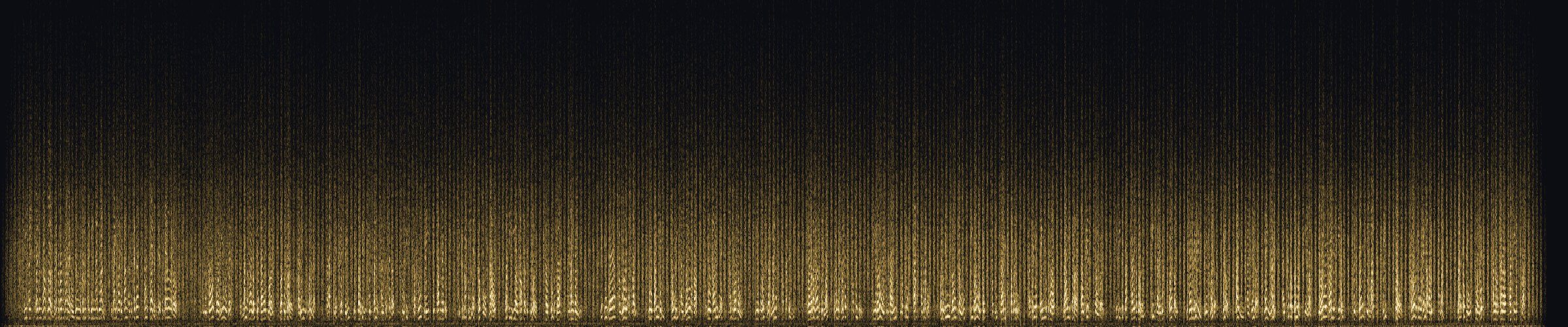
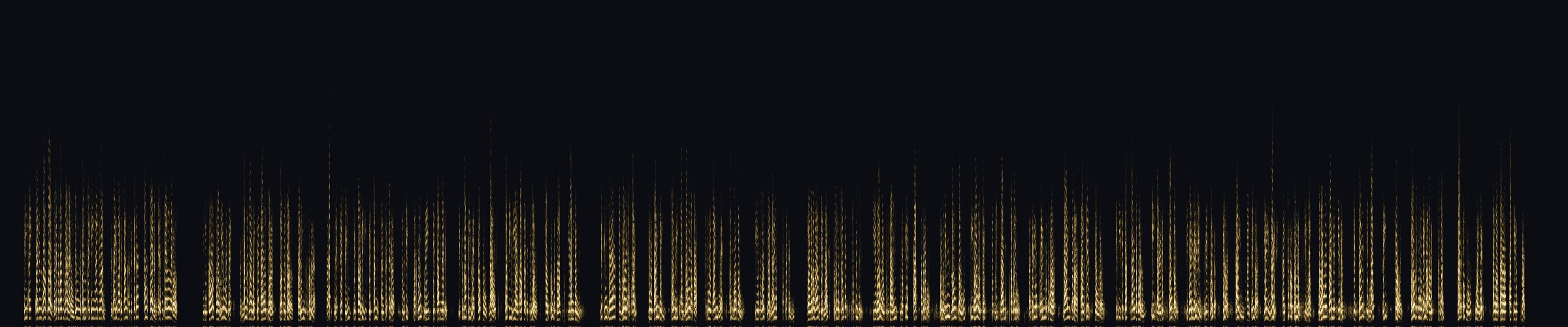
Spectrograms of the complete recording, 0–8 kHz, drawn on one shared intensity scale spanning 72 dB. The restored version is shown with its −0.69 dB mastering gain undone so the two panels sit at comparable levels. Brighter is louder. Time runs left to right.
The spectrograms make the situation visible. In the transfer, speech is a set of faint vertical striations inside a bright, continuous haze that reaches the top of the picture. That haze is not the room; it is surface noise, hiss and encoder artefacts, and they overlap with the voice rather than sitting beside it. Energy removed as noise can also contain parts of the voice, and every stage below had to be weighed against that.
The low-band envelope of the transfer, 8–130 Hz, from 24 to 27 seconds in. Dashed marks are spaced 0.395 s apart. The pulse is what stage 2 subtracts.Speech-window spectra, transfer against selected cleanup, level-matched in the speech band. Schematic redrawn from the measured curves; the dominant balance is the same in both.
Two measurements argued against ambition. Above 4.5 kHz the raw and cleaned signals had a coherence of about 0.11, meaning what remains up there is noise, not a reservoir of missing consonants that a cleverer filter could return. And below 140 Hz the transfer had barely more energy during speech than during pauses, so there was no vocal “body” waiting to be recovered by a bass boost. What the file offers is what the file offers.
The transformations
Eight steps from the MP3 to the master
This is the exact chain that produced the restored version you can hear above, in order. Each step says what it did, and what it cannot claim. Only one step is a learned model, and it is marked. Nothing here writes new speech.
1
Decode and remove DC
Linear
The MP3 was decoded once to a 16-bit mono WAV at its native 44.1 kHz, and that decode was fixed as the working input for the whole project. The mean of the signal was subtracted to remove any DC offset. Speed and pitch were left exactly as the transfer has them.
A fresh decode differs from the working WAV by at most half a 16-bit step. Both are preserved, and this page serves the MP3 itself.
2
Subtract the repeating thump
Event template
Likely thumps were found on the 8–130 Hz envelope, with at least 0.32 s between events. Each detected event's full-band waveform was stacked, a median template was taken and Hann-windowed, then fitted to each event by projection (gain clipped to 0–3) and subtracted. An 80 Hz fourth-order Butterworth high-pass, run forward and backward, followed.
The template is built from waveform segments, so vocal material can enter it. This is detection and subtraction, not a physical model of a rotating carrier.
3
Neural denoising
Learned model · Resemble Enhance, denoise only
The de-thumped signal was passed through Resemble Enhance's --denoise_only mode. The full enhancement mode was also tested and rejected. The output was aligned back to the original at 44.1 kHz (zero-sample delay) and its speech-active level matched within about 0.06 dB, so that loudness alone could never decide a comparison.
This is the one stage that alters the signal with a learned prior, and it is the main reason the noise is gone. The exact model checkpoint hash was never recorded, so a byte-identical rerun of this stage cannot be promised. Every later stage can be reproduced exactly from its saved output.
4
Light stationary noise reduction
Spectral
A conventional spectral gate (noisereduce) with a stationary profile taken from the first 0.6 s and a reduction strength of 0.35.
The first 0.6 s was a practical profile choice, not proof of a speech-free interval. The strength parameter is a library control, not a measured percentage of noise removed.
5
Band-pass to the useful range
Linear
85 Hz to 5,600 Hz, third-order Butterworth, forward and backward. This produced the version known internally as m5r26, which listening rounds preferred over the other conventional and neural candidates, and which remained the fixed baseline for all later work.
Two intermediate files in this lineage were written as 16-bit despite being labelled float. Later stages are 32-bit float, but that cannot undo the earlier quantisation.
6
A gentle, fixed tonal rebalance
Linear · 1,025-tap FIR
The listener reported that most of the noise was gone but the voice still sounded “squished.” Since the boxed-in balance was measured to be in the transfer itself, the answer was not more suppression but a small, explicit equalisation: three broad Gaussian bumps in log-frequency, tapered to unity below 100 Hz and above 5.5 kHz.
The target curve, computed here from the published formula. It is sampled at 2,049 points and turned into a symmetric 1,025-tap filter with SciPy's firwin2, applied by centred convolution so nothing shifts in time. The exact coefficients are published.
Component
Centre
Nominal
Width (σ, octaves)
Body
200 Hz
+2.5 dB
0.70
Dominant-midrange cut
480 Hz
−2.5 dB
0.80
Speech presence
2,300 Hz
+3.0 dB
0.85
Because the speaker of the opening announcement is uncertain, the announcement keeps the untouched baseline. The equalisation is faded in with a raised-cosine weight between 17.5 and 18.5 seconds, just before Thomas begins his preface.
This is a listener-preferred hypothesis about a more natural balance, not an inverse of the recording horn. On simulated damage it helped a 450 Hz coloration by 0.97 dB, did nothing for an 850 Hz one, and made a flat-response control 0.40 dB worse. It is not a universally correct filter. Speaker-embedding and attack-envelope checks against the baseline came out at or near 0.99, which bounds the change without certifying the voice.
7
Level to −20 LUFS
Constant gain
For the final blind comparison, each complete candidate received one constant gain to land at approximately −20 LUFS integrated loudness. For the tonal version that was −0.69 dB. Peaks were checked at −2.96 dBTP.
FFmpeg's loudnorm was used only to measure. Its output was discarded. There is no compressor or limiter anywhere in the chain.
8
Blind choice: X or Y
Listening
Baseline (X) and tonal (Y) were served level-matched under private labels. The listener chose Y, but reported something that sounded almost like clipping.
Checks found no full-scale samples and an oversampled peak of about −2.95 dBFS in the served file. Digital clipping is ruled out to the precision examined. A copy 6 dB quieter was made purely as a level diagnostic; on relistening, the roughness was reconsidered as possibly the speaker's own shakiness, and the archived collection kept that quieter copy as its selected file. This page serves the Y master itself, since the two differ only by a constant gain. Distortion from the transfer or the denoiser, made more audible by the equalisation, remains possible. Pitch stabilisation, tremor removal or further smoothing were deliberately not applied on the strength of an ambiguous impression, and no medical inference about the speaker was drawn.
Branches that were cut
What was tried and left out
The project produced a great deal of audio that is not in the master. Experimenting with a method is not the same as including it. These were all rejected, most of them because they made the recording sound better while making it less true.
Full neural enhancementResemble Enhance's enhancement mode, VoiceFixer, DeepFilterNet and ClearVoice were all compared. Stronger processing put speech into the residual or added its own texture. Only denoise-only Resemble survived listening.
Bandwidth extension and high-band synthesisAdding generated energy above 5 kHz looked better on a spectrum and could not be shown to preserve the original articulation. Rejected in the September tests.
Voice cloning, donor readings, voice conversionDesigned and cloned voices, readings by other speakers converted toward Thomas, and phrase retiming all produced something cleaner and something else. Reports describe double voice, smear, slur and odd stresses. A polished new reading is not a restoration of this performance.
Sidon resynthesisA resynthesised version scored well on some measures and acquired new transcription disagreements. Rejected.
Extra spectral attenuation (“spectral2”)Passed a small known-answer benchmark by 0.72 dB, then lost a blind listening comparison to the existing baseline, which the listener weakly preferred and could barely distinguish. An important negative result: a gain on simulated damage did not translate to the real recording.
Selective return of source detailAdding back parts of the original-minus-cleaned residual in 900–4,600 Hz where coherence suggested real speech. Its measured benefit fell below the predeclared 0.10 dB threshold and it was dropped, alone and in combination with the tonal curve.
Speed or pitch correctionThe 0.395 s thump period could be turned into a supposed rotation speed only by assuming the carrier and the number of defects per turn. No such assumption was made, so the transfer's speed stands.
Choosing the version
How “best” was decided
Every decision that mattered was made by ear, in blind comparisons served under private labels, with measurements used to constrain the options rather than to pick the winner. The sequence that led to the master was short.
The existing cleanup was compared against a version with extra spectral attenuation. The listener weakly preferred the existing cleanup and said both still sounded restricted, though most of the noise was gone.
That pointed away from more suppression and toward body and openness. A bounded tonal experiment was designed with a frozen protocol, simulated damage cases, and speaker-identity guards, before any listening.
Baseline and tonal versions were compared blind at matched loudness. The listener preferred the tonal version but heard a roughness that sounded like clipping.
Delivery files were checked and showed no clipping. A −6 dB copy was supplied purely as a level diagnostic.
On relistening, the roughness was reconsidered as possibly shakiness in the voice itself. The archive kept the quieter copy as its selected file. This page serves the same master at its −20 LUFS level, since the two differ only by a constant gain.
“Best” on this page therefore means the version chosen by one listener from this body of work. It is not a certificate that an undamaged historical voice has been recovered, and it does not claim that no further improvement is possible.
Limits
What this page does not claim
That the carrier was authenticated. No cylinder, disc, ledger or transfer record was examined. The 1905 date rests on Taylor's account and the spoken announcement.
That every speaker is identified. The opening announcement may be read by someone other than Thomas. That is why it was left tonally untouched.
That the transcript is certified. The working transcript is a reference aid. The automatic recogniser disagreed with it in several places on every version, including the unrestored transfer, and those disagreements were kept rather than resolved by editing audio.
That the top end was recovered. Nothing above roughly 5.6 kHz was synthesised. The restored version is cleaner and clearer, not wider.
That Thomas sounds like Charles. Contemporaries heard a resemblance. A resemblance is all the surviving evidence supports, and nothing in this work attempts to derive the father's voice from the son's.
That the whole chain can be regenerated bit for bit. The neural stage's checkpoint identity is missing. From its saved output onward, the finishing has been reproduced independently with a maximum sample difference of exactly zero.
Files and verification
Download and verify
SHA-256 digests are given so anyone can confirm that what they downloaded is what was described. The two MP3s are exactly the files in the archived collection.
original_source.mp31.2 MBThe unmodified 2012 transfer as hosted by Taylor in 2013. 64 kbps mono MP3. This is the source artefact.cc2facc8d610af32a61c3cf23a02dfe29fcc11213e987dc38a76fc2428db8196
best_restored.mp33.6 MB192 kbps listening copy of the tone master, the exact file served in the blind comparison. A convenience encode, not the archival reference.e650639e988b2735ed47e1d96851d9730240408139161e0f7e835d8e2ca94c05
best_restored_24bit.flac8.1 MBLossless 24-bit FLAC made for this page from the 32-bit float tone master. The float WAV itself is 26.7 MB and is held in the archive.f383cad508b7a52b3552c13c3d055484ab47a07b878bb66c3b3cb8bed107cc2d
File
Loudness
True peak
Format
Original transfer
−18.19 LUFS
−0.56 dBTP
MP3 64 kbps, mono, 44.1 kHz
Restored master (WAV / FLAC)
−20.00 LUFS
−2.96 dBTP
32-bit float, mono, 44.1 kHz
Restored listening copy (MP3)
−20.26 LUFS
−3.23 dBTP
MP3 192 kbps, mono, 44.1 kHz
The archived collection behind this page also holds the original working WAV, the pre-tone cleanup WAV, stage hashes for every intermediate file, listening feedback, frozen protocols, benchmark results and snapshots of the historical code.
Printed sermon. C. H. Spurgeon, “The Statute of David for the Sharing of the Spoil”, 1 Samuel 30:21–25, Metropolitan Tabernacle, 7 June 1891. Metropolitan Tabernacle Pulpit, vol. 37, via the Spurgeon Center.
Fullerton quotation. W. Y. Fullerton, Thomas Spurgeon: A Biography (Hodder & Stoughton, 1919), on the Internet Archive, as quoted by Taylor, who gives the date as 1909.
Portrait of Thomas Spurgeon. Anonymous autotype, c. 1890–1895. Rijksmuseum, Amsterdam, object RP-F-F26790. CC0, via Wikimedia Commons. Cropped from the page scan.
Portrait of Charles Spurgeon. Photograph by the London Stereoscopic Company, autotype c. 1881–1891. Rijksmuseum, object RP-F-2001-7-67-53. CC0, via Wikimedia Commons. Cropped.
Metropolitan Tabernacle interior. Albumen print by George Washington Wilson, c. 1875–1900. Rijksmuseum, object RP-F-00-6310. CC0, via Wikimedia Commons. Cropped.
Susannah Spurgeon and her sons. From C. H. Spurgeon's Autobiography (1903), via Wikimedia Commons. Public domain.
Spectrograms, waveforms and charts. Computed for this page from the archived original WAV and restored master with NumPy and SciPy. The tonal curve is drawn live from the published formula.
Restoration. Carried out in stages between June and September 2026 as part of the Spurgeon project at computationaltheology.com.